Wednesday, October 12, 2016

Virat Kohli Lashes Out At Harbhajan Singh For His Tweet Blaming The Pitch For Less Wickets!

India defeated the Blackcaps in the third Test at the Holkar Cricket Stadium, Indore. India claimed a 321-run victory over New Zealand in the final test. India has conquered the test series by a white wash. Due to this 3-0 clean sweep, India has retained their No.1 position in the ICC Test Rankings. Indian team was presented the ICC Test Championship Mace by the little master Sunil Gavaskar after the Test.
But despite the victory, someone is still in a bad mood, someone is still feeling sour, and that someone is none other than Harbhajan Singh. The Turbanator tweeted expressing his disappointed with the pitch in Indore. He said that the pitch already looked like it was ‘two days old’. Not only this, he even made the bold prediction the final India vs New Zealand Test won’t last for more than three-and-a-half days. See his tweet..

To this a fan tweeted him asking where were his complaints when he was playing against AUS, SA in 2004, 2008.

But that’s not all, Harbhajan Singh went a step further and said that his test wicket count would have been very different if he had played on the same kind of pitches.

Although the off-spinner congratulated India on their 3-0 series win, but it looks like he didn’t make the comment in a good taste. Harbhajan is currently playing in the Ranji Trophy. The people on twitter took a jab at his comment.

Harbhajan Singh has taken 417 wickets, the fans told him to remember his class, and not be desperate to stay relevant.

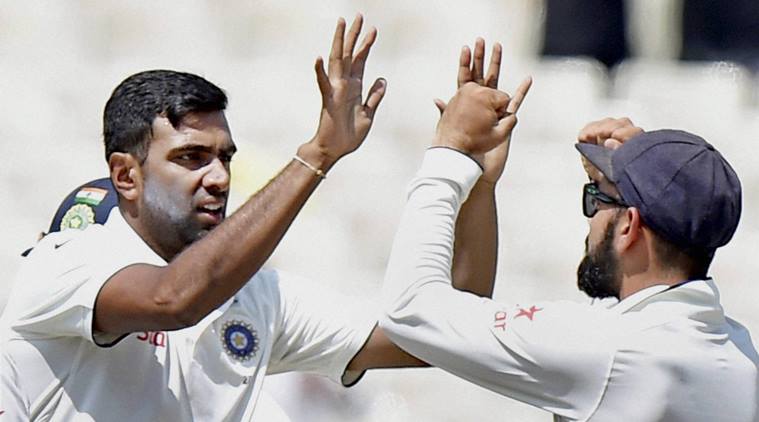
When the Indian test skipper Virat Kohli was asked about Harbhajan Singh’s recent tweet on the kind of pitches offered to Ravichandran Ashwin, Virat Kohli said,
Harbhajan Singh
Source
“Even if it is a turning pitch, you have to bowl well. Spin is just not something to happen only off the pitch. It depends on how many revs (revolutions) you give to the ball and the use of the shoulder. When we lost to New Zealand in the World Cup, I quite clearly remember, suddenly their spinners were quality bowlers and we were found out! I don’t see anyone talking about it now.”
Virat said that these were the same NZ spinners who were credited for victory against India in the World Cup. If they were that good then why did not they pick up wickets? Virat said that it’s all about mindset, Indian fast bowlers have picked up wickets everywhere. It’s not about pitch or conditions, but mindset.
So guys what do you make of Harbhajan’s tweets, do you agree with what Virat Kohli said? Do share your views and opinions in the comments!
News Source

Thursday, October 2, 2014

National Level Model Act on SHGs and SHG Federation​s

In India, the banking sector witnessed large scale branch expansion after the nationalization of banks in 1969, which facilitated a shift in focus of banking from class banking to mass banking. It was, however, realised that, notwithstanding the wide spread of formal financial institutions, these institutions were not able to cater completely to the small and frequent credit needs of most of the poor. This led to a search for alternative policies and reforms for reaching out to the poor to satisfy their credit needs. As an alternative to the formal financing system, the SHG Movement was initiated by some of the civil society organizations way back in the 1970's. After the initial struggle from these civil society organizations for long time, bank linkages for enhancing the credit access to women members took off as an important activity. Given this innovation, both Government and Formal Banking System started reacting favorably.
 
The National Bank for Agricultural and Rural Development (NABARD) started Self-help group (SHG) - bank linkage programme (SBLP) as a pilot project in 1992. This programme not only proved to be very successful, but has also emerged as the most popular model of micro finance in India. However, the limitations of an informal small group to undertake substantial investments in productive activities and also to provide universal financial inclusion (with wide range of financial services like savings, credit, insurance, pension and other services) become visible very soon. Therefore, Self Help Promotion Institutions (SHPIs) started promoting the concept of Federations of SHGs.  
 
Despite tremendous achievements of the self-help groups, recognized as the largest decentralized institutional mechanism to extend basic financial services in the World, the growth of the Self Help Groups and Federations are getting limited due to lack of appropriate legal framework. Most SHPIs are initiating SHG Federations as either Public Societies, Trusts or Cooperatives. In seven states of the country, the most frequently used legal act is the Self Reliant Cooperative Societies Acts. Post 97th Amendment of Constitution, where in Republic of India recognized that it is fundamental right of citizens of India to form cooperatives, there was a ray of hope that a member/citizen centric framework independent of government control will be established. However, in 97th Amendment, part IXB goes on to prescribe provisions of bylaws of cooperative societies. Keeping this as ruse, both Madhya Pradesh and Odisha State Governments quickly repealed the Self Reliant Cooperative Societies Acts operational in their states. 
 
Given this background, it is clear that at the National Level there is no appropriate legal framework which is sensitive to the needs of informal Self Help Groups and their federations. Under the context of National Level scaling up of Self Help Groups as part of National Rural Livelihoods Mission, it will be quite appropriate to debate and discuss on the appropriate legal framework for SHGs and SHG Federations. This will be equally relevant for National Urban Livelihood Mission.

Friday, January 18, 2013

A Collective Farming Group Leader - Seema Devi


Quates from Ms. Seema Devi:--
We all are associated with PRAGATI since 2006. After the association with organization, their staffs used to come and we started our group meetings. We also discuss for savings in meetings. We have taken 10 katha agriculture land on lease in 2009. Problem of Food insecurity lessen after starting farming. We are now satisfied now. Our children are now  going to schools. Now women of group don’t have to take loan from money lenders.

This is the success journey of women group who organized themselves as institution and started collective farming while taking agriculture land on lease to overcome from the challenges of hunger and denied to work as daily wage labour. Capacity building training programs of local organization called Pragati Grameen vikas Samity organized them and strengthen them to realize their rights over land and livelihood. Vital role played by the women of this group in land movements given them recognition as women leaders and inspiring other women to join the struggle for identity and recognition as women farmer in the society.  

There is a woman farming group in Devnarayan Nagar tola of Baruhi Village who has 11 women members. This is belongs to Mushar community organized and formed its institution in 2009. This is being led by Ms. Seema Devi.

Before the intervention of the organization, the Mushar community of Baruhi village was facing the challenges of landlessness, poor economic scenario of Dalit households, and no access to health and education. Migration was another serious issue that enforces the Dalit women remained alone in villege with children and work as daily wage labor on others land. Daily wage labour works are only available hope for their survival in agriculture seasons and remaining period; they have to face the painful challenge of hunger. The Dalit community of Baruhi village got associated with Organization in 2006. The organization started sensitizing the Dalit community on their rights and entitlements. In this process Pragati has started orienting community to realize their strengths and further organized as issue based units. There was one of the groups of women from Mushar community in Baruhi village who formed their institution as mutual helped group. This women group came forward and started saving credit activities that strengthened their group for further intervene in livelihood activities. While ensuring active participation in Land movements of organization to access homestead land, this women group has also acquire 0.30 land on lease for group farming and collectively these women started cultivating potatos, Paddy, Pulse and other seasonal crops. The group has transplanted paddy on 0.30 decimal area of land by taking it on lease and paid 3000 rupees to landowner as well as group has also planted potato and Masur (Pulse) on waste land that was around 0.45 decimal. Joint efforts of the group produced 800 kgs Potato, 640 kgs Paddy and 80 kgs Masur (Pulse).

The women of that were glad to achieve the success in terms of yields which has partially ensured their food grain need of households especially during the lean period agricultural seasons. This locally discovered land associated livelihood option supports their household food need to all women members of that group along with also shown them a way to ensure women’s rights over land and further recognition as women farmer. This women as farming groups specially Ms. Seema Devi inspiring other women to adapt collective farming a successful land based agriculture model for food security and livelihood.
Broader perspective of this women group is to acquire the identity as farmer so that they could avail the entitlements of various national and state sponsored schemes on smallholder agriculture. With this perception they will also ensure women’s rights over land an integral part of their livelihood for their economic feasibility.


Thursday, October 11, 2012

A community driven initiative (AJEEVIKA SAHAYATA KENDRA )


Dalit and Tribal communities are always core agenda of development for government and non-government organizations in India. There are uncounted numbers of centrally sponsored schemes are running across rural areas in our country to support the deprived people living in village with their unfavorable situations. Unfortunately, these schemes are not producing fruitful impact on the target beneficiaries whereas a central and state government has made efforts to deliver it with its actual objective. Due to the huge gaps between right holder and duty bearers and lack of accessibly to information regarding these schemes among the community made the allotments lengthy. There is opportunity is being created for middle man. Duty bearers are non-responsive towards the right holders who are forced to live painful life. Lack of ownership over natural resources and poor livelihood opportunity put their life in food insecurity that causes huge migrations.


Community driven Center for rights based interventions
Prgati Grameen Vikas Samiti have started a community driven initiative called MNREGA Sahayta Kendra (MNREGA Assistance Center) in its preliminary stage to increase the accessibility to livelihood opportunity thus the migration and poverty can be tackle. As these centers were in their primary stage with certain objectives, it was only serving those beneficiaries who are eligible to be benefited under the centrally sponsored schemes MNREGA but still neglected. Few villagers have job cards but no work to do. Few have applied for job but no work allotted under MNREGA. Most of them do not have even job cards. MNRGA Sahayta Kendra established at panchayat level facilitating these underprivileged communities to access the entitlement under this livelihood security schemes. Advocacy efforts were being made through these centers for job. Overall functioning of these centers had proven its means of establishment. Now beneficiaries are well aware of provisions and entitlements under the centrally sponsored scheme of MNREGA.

Pragati Grameen Vikas Samiti is working for Dalit and Tribal to ensure their rights over natural resource like water, forest, land etc. with support of Oxfam India. As we know that these natural resources are the foundation of sustainable livelihood for rural mass. Dalit and Tribal communities in Bihar are still deprived a segment of our society who has long association with natural resources and still they are dependent over natural resources. Homestead land right and Forest rights act are promising the Dalit and Tribal for their rights over property, but somehow these entitlements are unable to reach the right beneficiaries. Pragati Grameen Vikas Samiti have established livelihood assistance centers in fifty panchayats to provide a platform to the disposed communities to be united and demand their rights to land and livelihood. These centers were initially facilitating the discussions around the land and livelihood issue; therefore it started supporting the communities in generating demand of rights. Collectivized submissions of applications were being submitted to the block officials against different schemes. Follow up of submitted application were undertaken through the centers. Communities were started advocating for their rights through protest and foot march. Awareness has been enhancing regarding the rights of people over the land and livelihood.

Accessibility to the social security and livelihood schemes is being increased through these established ASKs and now it also supporting by ensuring the information flow of govt. schemes for smallholder farmers. With the positive hope, our endeavors are making smallholder agriculture a profitable agro-sector and will mobilize resources for farmers and policy reforms for smallholder agriculture in Bihar as well as recognition of women as farmer.